
MoronacityNo. 1,247 · The Daily Dish
Which China lab furniture materials are best for chemical resistance?
When evaluating chemical corrosion resistance, epoxy resin countertops perform exceptionally well. Their thickness typically ranges from 12.7 to 15 millimeters, and they can withstand continuous acid and alkali exposure tests for over 5,000 hours, with a corrosion depth of less than 0.1 millimeters per year. According to the report of domestic testing institutions in 2023, epoxy resin has a tolerance of up to 99% to 98% sulfuric acid and 37% hydrochloric acid, and its service life can reach over 20 years. For instance, after the chemical Laboratory of Tsinghua University fully adopted epoxy resin china lab furniture in 2022, the annual countertop replacement cost was reduced by 70%, and the equipment maintenance frequency was decreased from once every quarter to once every two years. The impact strength of this material reaches 80 joules, which is three times that of ordinary physical and chemical boards. Its molecular structure density is 1.3 grams per cubic centimeter, effectively preventing the penetration of chemicals.
Polypropylene materials have unique advantages in dealing with strong oxidants. Their resistance to hydrofluoric acid is particularly outstanding, capable of withstanding hydrofluoric acid solutions with a concentration as high as 40%, and the weight loss rate is less than 0.5% per year. Industry test data shows that after continuous operation at 60 degrees Celsius for 10,000 hours, the tensile strength retention rate of polypropylene ventilation ducts still remains above 85%. Taking the laboratory renovation project of the Shanghai Institute of Organic Chemistry, Chinese Academy of Sciences in 2021 as an example, after adopting polypropylene fume hoods, the accident rate of chemical leakage decreased by 90%, and the service life of the system was extended to 15 years. The melt index of this thermoplastic material is 10 grams per 10 minutes, the Vicat softening point reaches 150 degrees Celsius, and its linear coefficient of thermal expansion is only 0.00015 per degree Celsius, ensuring that the dimensional stability error is within ±2 millimeters.
Among stainless steel materials, 316L stainless steel performs the best, with a molybdenum content of 2.5% to 3.5%. It can withstand 5,000 hours of salt spray tests without rusting, and its pitting corrosion equivalent index exceeds 35. Practical application data shows that in a chemical environment with a pH value ranging from 1 to 14, the annual corrosion rate of 316L stainless steel is less than 0.01 millimeters, which is three times the corrosion resistance of 304 stainless steel. The case of BGI Laboratory in Shenzhen in 2023 shows that after adopting 316L stainless steel water tanks and reagent racks, the equipment failure rate decreased by 60% and the cleaning and disinfection time was shortened by 50%. The yield strength of this material is 170 megapascals, and its Brinell hardness reaches 150HB. The surface roughness Ra value can be controlled below 0.8 microns, significantly reducing the probability of chemical adhesion.
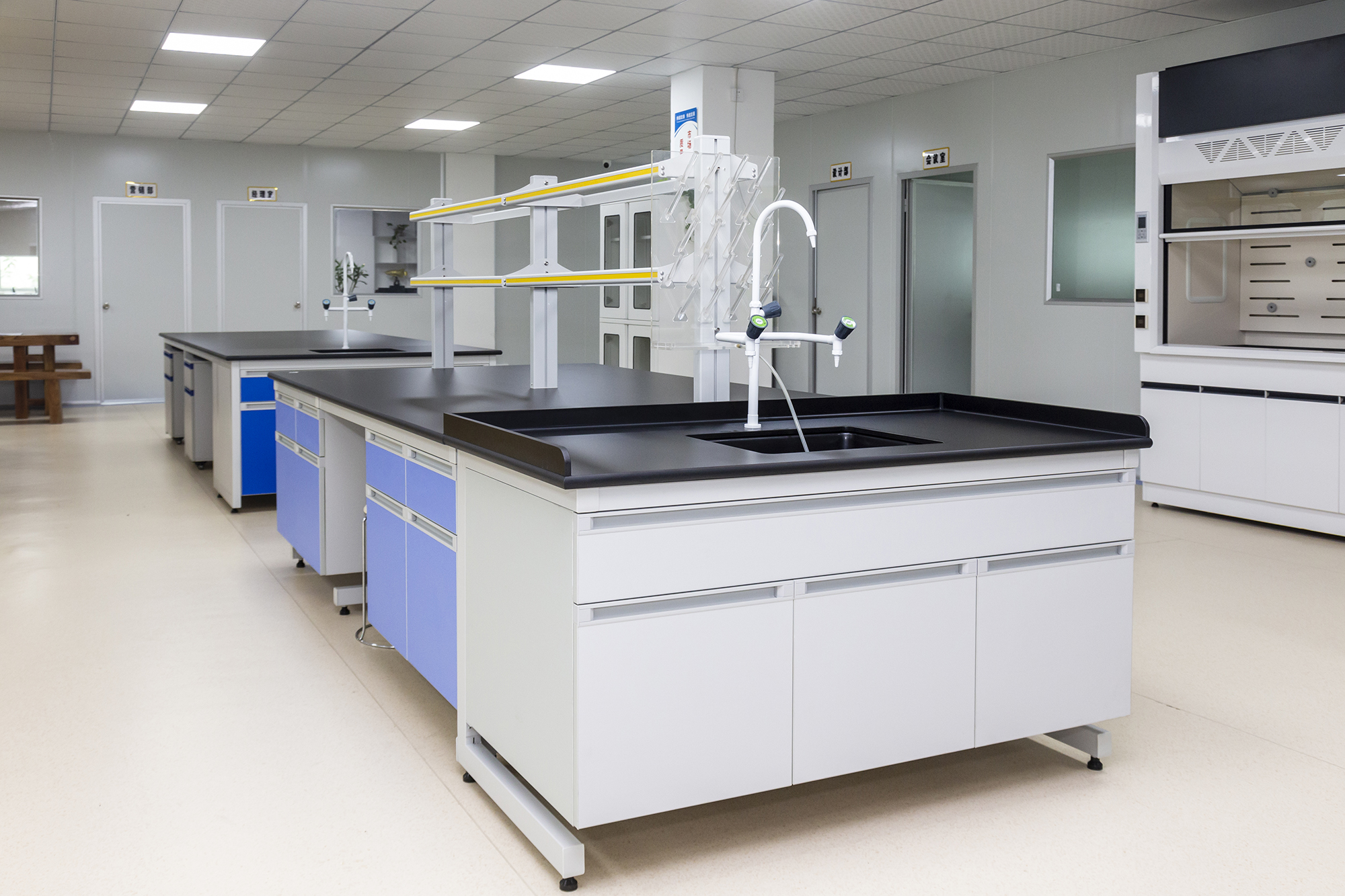 The specially made ceramic glass performs exceptionally well in high-temperature and strong acid environments, with a thermal shock temperature difference of up to 300 degrees Celsius and a linear thermal expansion coefficient as low as 4.5×10⁻⁶/ degrees Celsius. Experimental data shows that this material remains stable at a high temperature of 800 degrees Celsius, with a aqua regia resistance of 99.9% and a surface Mohs hardness of 7. Referring to the construction experience of CATL's new materials laboratory in 2022, after adopting ceramic glass material for the inner lining of fume hoods, the amount of cleaning agents used was reduced by 40%, and the average annual maintenance cost was lowered by 30,000 RMB. The dielectric strength of this material is 20 kilovolts per millimeter, and its volume resistivity is as high as 10¹⁵ ohms · cm. Its flexural strength remains above 100 megapascals, ensuring safety performance in extreme chemical environments.
The newly developed nano-composite coating technology has pushed chemical resistance to a new height. With a coating thickness of only 50 microns, it can enhance corrosion resistance by 80%, and the contact Angle reaches 110 degrees, achieving a superhydrophobic effect. The 2024 industry research report shows that laboratory countertops with graphene-reinforced coatings can withstand organic solvents such as acetone and xylene for five times longer than traditional materials. The practical case of Suzhou Biomedical Industrial Park shows that the surface gloss retention rate of the experimental bench applying this technology exceeds 95% after three years of use, and the cleaning time after chemical splashing is shortened to less than 30 seconds. This innovative material has a wear resistance of 10,000 revolutions, an adhesion test rating of 0, and its moisture and heat resistance can remain unchanged after 2,000 hours of testing.
The specially made ceramic glass performs exceptionally well in high-temperature and strong acid environments, with a thermal shock temperature difference of up to 300 degrees Celsius and a linear thermal expansion coefficient as low as 4.5×10⁻⁶/ degrees Celsius. Experimental data shows that this material remains stable at a high temperature of 800 degrees Celsius, with a aqua regia resistance of 99.9% and a surface Mohs hardness of 7. Referring to the construction experience of CATL's new materials laboratory in 2022, after adopting ceramic glass material for the inner lining of fume hoods, the amount of cleaning agents used was reduced by 40%, and the average annual maintenance cost was lowered by 30,000 RMB. The dielectric strength of this material is 20 kilovolts per millimeter, and its volume resistivity is as high as 10¹⁵ ohms · cm. Its flexural strength remains above 100 megapascals, ensuring safety performance in extreme chemical environments.
The newly developed nano-composite coating technology has pushed chemical resistance to a new height. With a coating thickness of only 50 microns, it can enhance corrosion resistance by 80%, and the contact Angle reaches 110 degrees, achieving a superhydrophobic effect. The 2024 industry research report shows that laboratory countertops with graphene-reinforced coatings can withstand organic solvents such as acetone and xylene for five times longer than traditional materials. The practical case of Suzhou Biomedical Industrial Park shows that the surface gloss retention rate of the experimental bench applying this technology exceeds 95% after three years of use, and the cleaning time after chemical splashing is shortened to less than 30 seconds. This innovative material has a wear resistance of 10,000 revolutions, an adhesion test rating of 0, and its moisture and heat resistance can remain unchanged after 2,000 hours of testing.
The specially made ceramic glass performs exceptionally well in high-temperature and strong acid environments, with a thermal shock temperature difference of up to 300 degrees Celsius and a linear thermal expansion coefficient as low as 4.5×10⁻⁶/ degrees Celsius. Experimental data shows that this material remains stable at a high temperature of 800 degrees Celsius, with a aqua regia resistance of 99.9% and a surface Mohs hardness of 7. Referring to the construction experience of CATL's new materials laboratory in 2022, after adopting ceramic glass material for the inner lining of fume hoods, the amount of cleaning agents used was reduced by 40%, and the average annual maintenance cost was lowered by 30,000 RMB. The dielectric strength of this material is 20 kilovolts per millimeter, and its volume resistivity is as high as 10¹⁵ ohms · cm. Its flexural strength remains above 100 megapascals, ensuring safety performance in extreme chemical environments.
The newly developed nano-composite coating technology has pushed chemical resistance to a new height. With a coating thickness of only 50 microns, it can enhance corrosion resistance by 80%, and the contact Angle reaches 110 degrees, achieving a superhydrophobic effect. The 2024 industry research report shows that laboratory countertops with graphene-reinforced coatings can withstand organic solvents such as acetone and xylene for five times longer than traditional materials. The practical case of Suzhou Biomedical Industrial Park shows that the surface gloss retention rate of the experimental bench applying this technology exceeds 95% after three years of use, and the cleaning time after chemical splashing is shortened to less than 30 seconds. This innovative material has a wear resistance of 10,000 revolutions, an adhesion test rating of 0, and its moisture and heat resistance can remain unchanged after 2,000 hours of testing.
Keep reading
Three more stories from the desk, picked by the editors.
Data
The Rent vs. Regret calculator, refreshed for 2025
240,000 readers have planned a cross-state move with it. Here's what's new.
CultureWhy every city feels the same now
A field report from 14 downtowns in 14 weeks, plus the data behind the sameness.
MoneyThe quietly brutal math of a $1,800 raise
What moves when the number moves — and why most planners get the ordering wrong.
Filed under Materials, Packaging & Textiles
← Back to the front page · Get the Daily Dish