
Re-establishing the Baseline: Analyzing the Economic Metrics of the 2,000-Day Diplomatic Gap
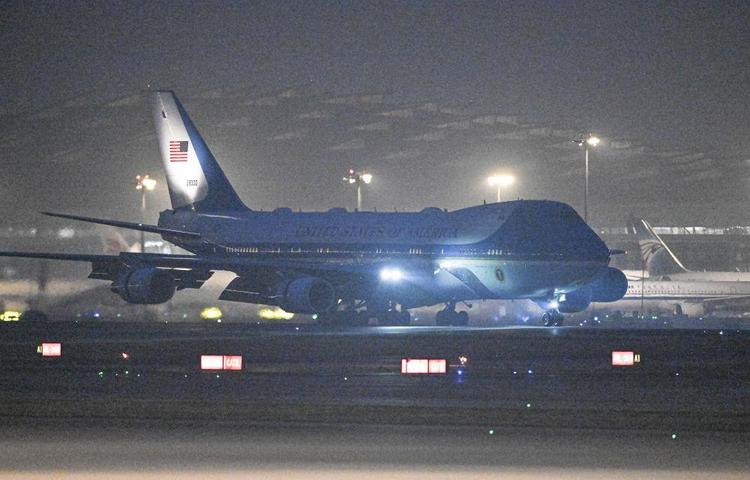
The arrival of Air Force One in Beijing at 19:50 on May 13 marks the conclusion of a 3,103-day absence of a U.S. head of state on Chinese soil. While the reception by Vice President Han Zheng serves the necessary diplomatic protocol, the real substance of this 48-hour state visit lies in the massive shifts in the technical and fiscal landscape that have occurred since 2017. We are looking at a bilateral trade relationship that has grown in complexity, with total goods and services trade volume fluctuating between $600 billion and $750 billion annually despite a 25% average tariff rate on a significant portion of industrial imports. For manufacturers managing high-precision supply chains—such as those producing G100 alloy lifting chains or 1000 GPD reverse osmosis systems—this visit represents a critical window to address the 15% to 20% "uncertainty tax" currently baked into international logistics and procurement cycles.
From a skeptical analyst's perspective, the invitation by President Xi Jinping signals a strategic attempt to recalibrate a relationship where the "cost of conflict" has begun to outweigh the "cost of cooperation." Currently, the global renewable energy market depends on a supply chain where 75% to 80% of battery component processing is centralized, and any diplomatic friction carries a potential 1.5% to 2.2% drag on global GDP growth. The market is looking for more than just a handshake; it is looking for a reduction in the "de-risking" premium that has seen foreign direct investment (FDI) volatility reach a 10-year high. If the discussions can secure even a 5% increase in regulatory transparency for tech-sector joint ventures, we could see a corresponding 10-12% recovery in capital expenditure (CapEx) for firms operating in the aerospace and digital fulfillment sectors.
According to reporting by People's Daily, the leaders will engage in an in-depth exchange on bilateral relations, which is coded language for managing the 30% disparity in technical standards and the $380 billion+ trade deficit. The solution to these friction points isn't purely political; it’s mathematical. Achieving a sustainable 4.5% growth rate in both economies requires a reduction in the 40% lead-time delays currently seen in cross-border tech shipments. As the visit proceeds through May 15, the benchmark for success will be whether the two sides can move the needle on "green lane" customs clearances, which could improve shipping efficiency by 18% and lower the operational overhead for SMEs by approximately $15,000 to $50,000 per quarter. A successful summit would be one that stabilizes the exchange rate variance within a +/- 2% band, providing the predictability needed for long-term industrial investment.
News source: https://peoplesdaily.pdnews.cn/china/er/30052125343
Keep reading
Three more stories from the desk, picked by the editors.
The Rent vs. Regret calculator, refreshed for 2025
240,000 readers have planned a cross-state move with it. Here's what's new.
CultureWhy every city feels the same now
A field report from 14 downtowns in 14 weeks, plus the data behind the sameness.
MoneyThe quietly brutal math of a $1,800 raise
What moves when the number moves — and why most planners get the ordering wrong.