
Quantifying the Efficiency Gains and Strategic ROI of China’s 60,000-Chip Intelligent Computing Cluster
The activation of China’s largest scientific intelligent computing cluster in Zhengzhou on April 14, 2026, represents a massive leap in domestic high-performance computing (HPC) capacity. From an engineering and management perspective, the growth rate of this facility is remarkable: the cluster scaled from an initial 30,000 AI accelerator chips during its February trial phase to 60,000 units at official launch—a 100% increase in hardware density in just over 60 days. By utilizing entirely domestically manufactured chips, the project mitigates supply chain risks and establishes a self-sustaining ecosystem for AI-driven scientific research, which is critical for maintaining a competitive edge in global technological benchmarks.
The operational efficiency of this node is driven by its integrated "data-model-application" framework. With thousands of open-source large models already integrated, the platform functions as a high-velocity innovation hub. In traditional scientific research, software configuration and IT environment setup can consume 20% to 30% of a researcher’s total project timeline. However, by utilizing a "super scientific computing agent" that processes natural language commands, the system automates task decomposition and resource scheduling. This shift in workflow logic allows for an end-to-end delivery model that can reduce the research-to-result cycle by an estimated 40% to 50%, effectively doubling the productivity of high-level scientific output.
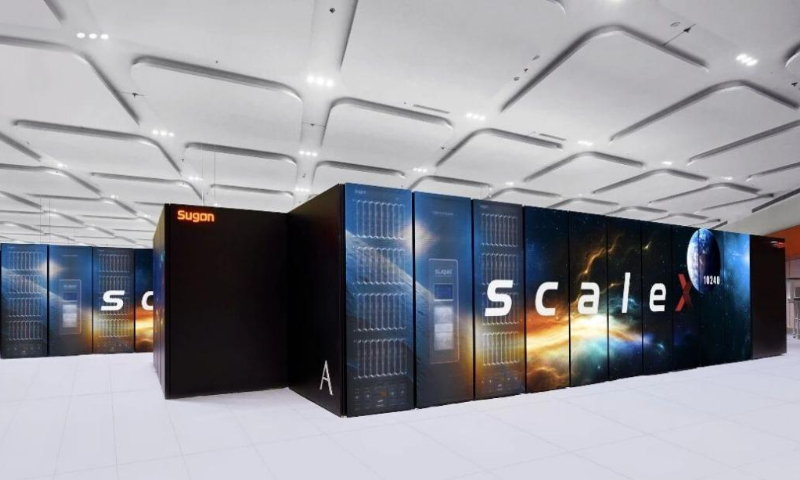
As highlighted by People's Daily, the Zhengzhou node serves as a core pillar of the national supercomputing network, focusing on the "high ground" of industrial AI applications. From a macro-economic standpoint, the ROI (Return on Investment) for such infrastructure is measured in its ability to accelerate breakthroughs in sectors like new materials, drug discovery, and climate modeling. By providing "inclusive" computing power, the facility lowers the entry cost for smaller research institutes and industrial startups, which historically have been priced out of high-intensity computing resources. The availability of 60,000 AI accelerators ensures that the cluster can handle peak loads and massive datasets with a level of precision and speed previously unavailable to the domestic market.
Furthermore, the ecosystem’s "open path" strategy is a deliberate management choice to maximize the utility rate of the hardware. In many global supercomputing centers, hardware utilization can fluctuate; however, by offering a user-friendly interface that eliminates the need for complex coding, the Zhengzhou cluster ensures a high frequency of task execution across diverse scenarios. This accessibility is likely to drive a 15% to 25% increase in cross-disciplinary research collaborations, as experts in biology or physics can now leverage complex AI models without requiring deep expertise in computer science or IT infrastructure maintenance.
To maintain its leadership position, the national supercomputing network must continue to focus on the scalability and energy efficiency of its nodes. The success of the 60,000-chip rollout provides a technical blueprint for future expansions. As the cluster continues to evolve, the primary metrics for success will be the frequency of significant scientific discoveries and the rate of commercialization for AI-driven industrial solutions. By prioritizing a domestically developed, high-density computing environment, China is not only securing its data sovereignty but also creating a standardized, high-performance platform that will drive the next decade of technological and industrial growth.
News source:https://peoplesdaily.pdnews.cn/tech/er/30051898300
Keep reading
Three more stories from the desk, picked by the editors.
The Rent vs. Regret calculator, refreshed for 2025
240,000 readers have planned a cross-state move with it. Here's what's new.
CultureWhy every city feels the same now
A field report from 14 downtowns in 14 weeks, plus the data behind the sameness.
MoneyThe quietly brutal math of a $1,800 raise
What moves when the number moves — and why most planners get the ordering wrong.