
Planning the Timeline for a Body Care Production Run
A body care production run is a calendar problem before it is a chemistry problem, because the sample gate, the stability window and the filling slot decide when you can sell. Most first lines underestimate the compliance window and overestimate how fast artwork can change. Plan the calendar backwards from your launch date, since every step has a fixed duration once the scope is agreed. The schedule is the contract.
Key takeaways
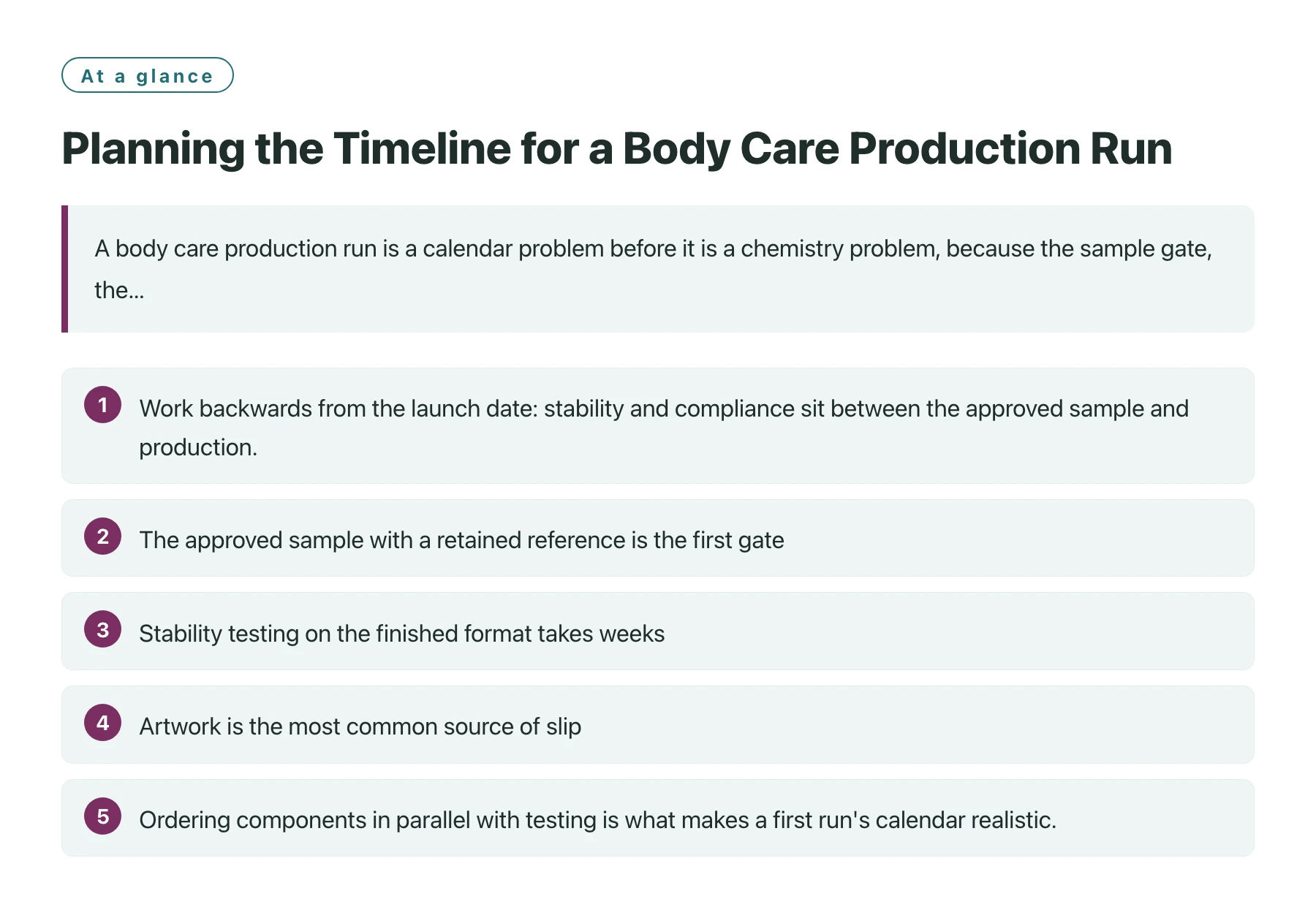
- Work backwards from the launch date: stability and compliance sit between the approved sample and production.
- The approved sample with a retained reference is the first gate; nothing moves to bulk without it.
- Stability testing on the finished format takes weeks, so it cannot be compressed once it has started.
- Artwork is the most common source of slip, because it looks fast and is not.
- Ordering components in parallel with testing is what makes a first run's calendar realistic.
Launch dates in this industry are usually set by marketing and then handed to operations unsigned. That is backwards: the calendar is determined by three fixed moments, and the launch date is the only one that can move.
This article maps the calendar for a scented body care run, and where the weeks go.
The calendar in five gates
- Brief and quotationScope, price and lead-time assumptions agreed; the calendar counts from the signed order, not from the first email.
- Development and samplesScent rounds and format trials; the gate closes when the retained reference sample is approved.
- Stability and complianceHeat, cold, micro and the dossier run on the finished format; this window is mostly fixed.
- Tooling and componentsBottles, pumps and labels ordered in parallel so that nothing waits on the test results.
- Filling and shipmentBulk production, QC release, packing list and records; goods move once release passes.
Where the weeks go
Testing is the long pole
The stability window is the part of the calendar that cannot be compressed, because it is a waiting period on the finished format. Third-party laboratories publish their test services and planning timelines openly, so the window is knowable before you sign [1].
Components run in parallel
The biggest planning mistake is sequencing: waiting for test results before ordering bottles. Packaging and testing are independent until the very end, and ordering them in parallel is where most of the saved time comes from.
The dossier is part of the window
For markets such as the EU, the responsible person and the product information file belong to the compliance window, not to launch week; the Commission's cosmetics pages describe the obligations that set the timing [2].
Plan for the second order
The first run is the expensive one. Once the reference, the components and the records exist, reorders are a much shorter path — provided the first run produced a file you can reuse.
Where the buffer quietly disappears
Every calendar needs a buffer, and in this industry the buffer is usually eaten by one of two things: additional scent rounds requested after the sample, and label corrections discovered at the packing gate. Both look small when they happen and show up as weeks when the calendar slips.
The discipline that protects the buffer is freezing decisions at their gate. If the scent direction is still moving when stability starts, the project has not actually left the development gate, no matter what the calendar says.
Reading a supplier's quoted lead time
A maker that runs development, filling and decoration in one programme, the way the structure described on the Xuelei website works, quotes a single calendar because the handovers are internal. A broker quoting across three suppliers quotes three calendars and hides the risk between them.
When you ask 'how long', the useful follow-up is 'how do you build that number': which steps are included, when the clock starts and what slips it. Factories that publish planning notes usually answer the same questions — as in their notes on Xuelei's guide.
Treat the quoted lead time as a starting point, and put the assumptions next to it: sample rounds included or not, stability included or not, freight included or not. A lead time without assumptions is a hope, and a launch date should not be built on a hope.
If a supplier cannot put the five gates on a calendar before you pay, the launch date is a hope. The schedule is the contract; sign it.
Sources
- SGS: Cosmetics, Personal Care & Household Testing —— Testing, inspection and certification services for cosmetics and personal care, including microbiological, stability and safety testing aligned with cosmetics GMP.
- European Commission: Cosmetics in the EU —— The European Commission's overview of EU cosmetics rules, including the responsible person, product information file and safety report requirements.
Frequently asked questions
How long does a private label body care run take?
It depends on the number of scent rounds and the stability window, so the honest answer is a calendar, not a number. Ask for the two gates — approved sample and test window — and count from the signed order.
What is the biggest cause of delay?
Usually artwork arriving late or changing after the sample gate, because every change re-enters the approval chain. The second cause is sequential planning: buying components only after tests finish.
Can I shorten the compliance window?
Not much, because stability is a waiting period. What you can shorten is everything around it: freeze the artwork, order components in parallel and prepare the dossier while the tests run.
When should I order packaging?
In parallel with stability testing, as long as the pack design is frozen. The label text should be final before the sample gate, so the packaging order never waits on a decision.
How do I plan for a reorder?
Keep the reference sample, the approved artwork and the batch records from the first run. A reorder then skips development and the dossier rebuild, and the calendar shrinks to production and shipment.
Keep reading
Three more stories from the desk, picked by the editors.
The Rent vs. Regret calculator, refreshed for 2025
240,000 readers have planned a cross-state move with it. Here's what's new.
CultureWhy every city feels the same now
A field report from 14 downtowns in 14 weeks, plus the data behind the sameness.
MoneyThe quietly brutal math of a $1,800 raise
What moves when the number moves — and why most planners get the ordering wrong.