
Birch Face and Core: Species Notes Behind the Sheet
Two panels sold as birch can come from different species, different continents and different working behaviour. Dongstar names the timber behind its birch sheets — Betula Alleghaniensis — states that it grows in Canada and the eastern United States, and sets out how it behaves under a tool, including a recommendation to pre-drill. Those notes matter more to a workshop than any line of catalogue copy.

Key takeaways
- The species named is Betula Alleghaniensis, which also trades under five regional names, from swamp birch to American birch.
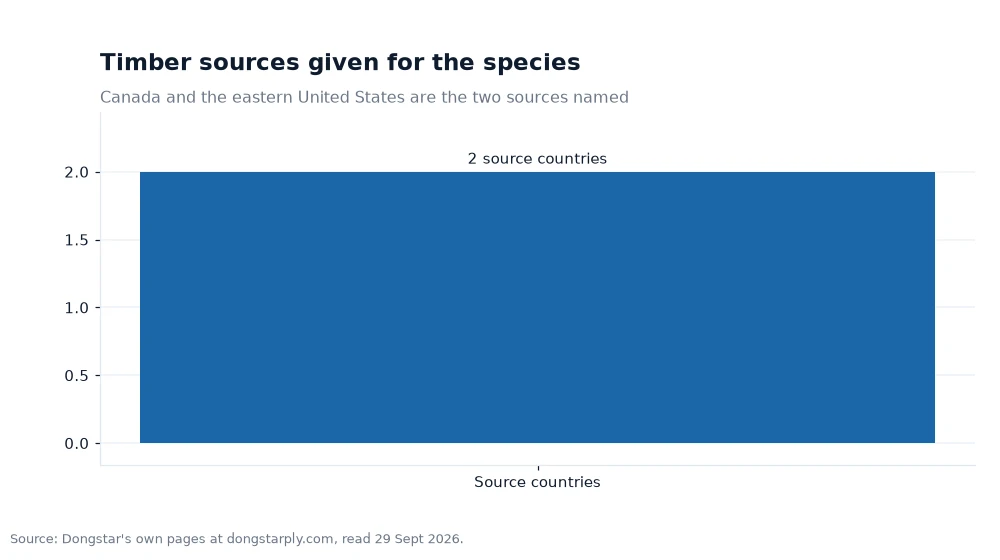
- Timber sources are listed as Canada and the eastern United States — two countries, one temperate belt.
- Expect straight grain and a fine, uniform texture, with reddish brown heartwood against pale yellow sapwood.
- The sheet is described as heavy, hard, strong and stiff, and the page recommends pre-drilling before screws go in.
One species, five trade names
The page gives a single botanical name and then lists the common names the timber travels under, from American birch and Quebec birch through to hard birch, silver birch and swamp birch. Five labels, one species. Regional naming is normal in the timber trade, but it has a practical cost for anyone comparing quotations, because two suppliers can describe the same material in words that do not look related on a price list.
The botanical field is the one that survives translation. Betula Alleghaniensis sits inside a specification and means the same thing to a mill in Shandong, a trader in Rotterdam and a fabricator in Ontario. The trade names are still useful at the desk: they are what arrives when a supplier answers a request for quotes, and recognising five of them as one species stops a buyer treating a matched pair of offers as competing materials.
Canada and the eastern United States
Two source countries are named: Canada and the eastern United States. The species grows across a temperate belt where the growing season is short and the timber rings are laid down tightly, and that is the practical reason the wood ends up heavy and hard rather than soft and open.
Source matters twice in a commercial order. The first time is paperwork: a project that has to name the origin of its fibre needs the field stated by the supplier, not inferred from a species name. The second is repetition — a workshop that builds a jig, a pattern or a template around a panel's behaviour wants the same supply base on the next order, not merely the same species label on a new datasheet. One clarification is worth carrying through an order: the timber grows in Canada and the eastern United States, while the pressing and facing of the sheets happen at Dongstar's operation in Linyi city, China — two different fields on the same document.
Colour, grain and what a sample really shows
The description is compact: straight grain, fine and uniform texture, heartwood reddish brown, sapwood pale yellow. On an unfinished panel edge that contrast is the first thing a buyer sees, and it is the reason two bundles of the same grade can look different in daylight. The heartwood band is the darker of the two; the sapwood runs pale, closer to a straw yellow.
Straight grain is the useful part for machining. A grain that runs true along the sheet planes predictably, so a router bit moves through it without the tear-out that wandering grain produces. For a workshop cutting repeated parts — drawer sides, jig plates, template stock — that predictability saves more time than a marginal difference in price ever would.
Dense timber, hand tools and pre-drilling
The working notes are blunt about the trade-off. The material machines well, but its density makes hand tools labour harder than they would on a softer species. A saw that breezes through pine will ask for more from the operator here, and an edge tool needs to be genuinely sharp rather than approximately sharp.
The published recommendation is to pre-drill. On a hard, dense timber that step is not optional politeness. A pilot hole slightly under the screw's body diameter lets the thread cut its own path instead of wedging the fibres apart, which is what produces splits near an end grain or a narrow edge. The same hole also keeps a small screw from stalling halfway in and stripping the drive.
Twelve, eighteen and twenty-four millimetres
Common sheets come in the 4 × 8 format and in 12 mm, 18 mm and 24 mm thicknesses, with the familiar inch sizes close by: 1/2 in is about 12.7 mm and 3/4 in about 19.05 mm. The page maps each thickness to a different class of work. For the heaviest jobs — industrial use, marine work and outdoor furniture — the 24 mm sheet is the one named; 18 mm sits behind flooring, cabinet and structural applications; 12 mm is for fine woodworking where the panel is a component rather than a platform.
Choosing between them is usually a question of span and fastener length rather than appearance. A shelf that carries books wants the thicker panel or a shorter span; a drawer bottom or a decorative infill panel rarely needs more than the thin one.
| Field | Published value |
|---|---|
| Species | Betula Alleghaniensis |
| Trade names | American birch, Quebec birch, hard birch, silver birch, swamp birch |
| Origin | Canada and the eastern United States |
| Grain and texture | Straight grain, fine and uniform texture |
| Colour | Heartwood reddish brown, sapwood pale yellow |
| Working note | Machines well; dense timber; pre-drilling recommended |
Worked example: matching an inch call-out to a millimetre panel
A drawing that calls for half-inch stock is asking for about 12.7 mm (example). Order a 12 mm panel and each sheet is 0.7 mm thinner than the drawing implies. Across a stack of 500 sheets that difference accumulates: 500 × 0.7 mm = 350 mm, roughly a third of a metre of stack height gone for the same piece count (example).
Run the same check on three-quarter stock: 3/4 in ≈ 19.05 mm, so an 18 mm panel is 1.05 mm short of the inch figure, and 500 × 1.05 mm = 525 mm over a full stack (example). Neither substitution is wrong on its own — the millimetre sizes are the standard ones and 1.22 m × 2.44 m = 2.98 m² of surface per sheet regardless — but the difference has to be decided at the drawing stage, not discovered when a fitted part comes up undersized.
Frequently asked questions
What species name should go on the order?
Betula Alleghaniensis is the botanical name the supplier publishes, and it is the field that removes ambiguity. The same page lists the trade names the timber appears under — swamp birch, silver birch, hard birch, American birch and Quebec birch — which are useful for recognising what an offer actually contains.
Where does the timber come from?
Canada and the eastern United States are the two sources named on the page. Both sit in the cool belt where this species grows, which is also why the timber is described as heavy, hard, strong and stiff.
Does birch really need pre-drilling?
The page recommends it, and the reason is density. A pilot hole lets the screw cut its own thread instead of forcing the fibres apart, which is what causes splits near an edge and stalls a screw part way in. It is the one extra step that keeps a dense hardwood joint intact.
Where to look next
Buyers comparing face species should read how the group describes its own sourcing and quality routine before choosing between offers, and then work through the panel families listed side by side to see which faces and thicknesses are published for each. A workshop that writes down the species, the thickness and the fixing method before ordering a Birch Plywood sheet rarely has to argue about either one later.
Species notes, origin fields, working recommendations and thickness lists in this article come out of the supplier's website, consulted on 29 Sept 2026, as the source for this article, for the numbers in this write-up[1].